
Sexual Interest by Age and Gender
Self-reported sexual interest across age, gender, and depression status in more than 140,000 SimilarMinds test responses.
The chart below summarizes responses to the personality-test item "I am very sexual", scored from 0 ("not very sexual") to 6 ("very sexual"). The analysis includes approximately 142,000 test takers between ages 13 and 60.
The broad pattern is nonlinear. Sexual self-ratings rise from adolescence into adulthood, remain relatively high through much of early and middle adulthood, and then decline more noticeably in some groups later in life.
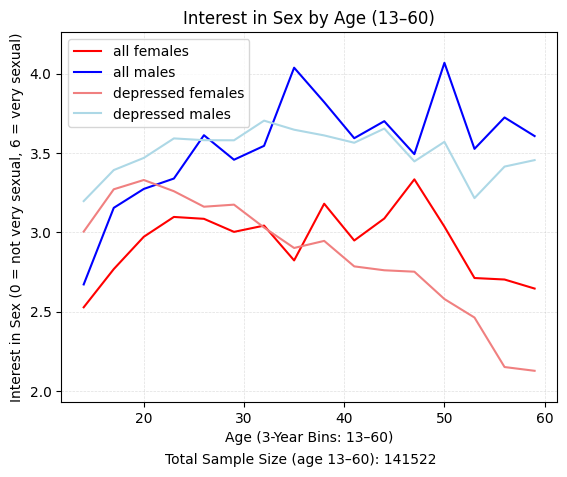
SimilarMinds data for "I am very sexual," shown in three-year age bins from 13–60. Total sample size shown in the original analysis: 141,522.
Male Pattern
Male sexual-interest ratings rise sharply from adolescence into the 20s and remain relatively elevated through the 30s and 40s. The chart also contains several midlife peaks rather than showing a simple steady decline from youth onward.
Female Pattern
Female ratings also rise from adolescence into early adulthood, but the overall trajectory is flatter and lower than the male trajectory. The decline becomes more pronounced after midlife in this sample.
Depression Before About 35
Among younger respondents, the groups labeled depressed report slightly higher sexual self-ratings than their same-gender comparison groups in several age bins.
Depression After About 35
Later in adulthood, that relationship reverses. The depressed groups generally report lower sexual interest, with the difference becoming especially large among women in the older age bins.
How These Results Compare With Other Research
Large population studies generally support two of the clearest patterns in the SimilarMinds data: men report higher average sexual desire than women, and desire changes with age rather than remaining constant across adulthood.
A 2026 Scientific Reports study using more than 67,000 participants found substantially higher average desire among men and an overall decline with age, with a steeper decline among women. That study also found that age effects were nonlinear rather than perfectly straight-line.
This makes the broad SimilarMinds age pattern plausible, although individual peaks in the chart—particularly the sharp increases around some midlife age bins—should be interpreted cautiously. They may reflect sampling variation, cohort differences, relationship status, medication exposure, or other factors not controlled in this simple descriptive graph.
Depression and Sexual Interest
The depression pattern is more complicated. Research in adolescents and young adults has sometimes linked depressive symptoms with greater sexual activity or sexual risk-taking, whereas adult research more consistently associates depression with lower desire and sexual dysfunction.
Medication may also matter. Antidepressants—particularly SSRIs—commonly reduce libido and sexual functioning. If antidepressant use becomes more common with age or with greater depressive severity, medication exposure could contribute to part of the later-life difference seen in the chart.
The graph itself cannot determine why these groups differ. Depression, medication use, relationship status, health, hormones, sexual orientation, cultural norms, and self-selection into an online personality test could all affect the observed averages.
Important Measurement Limits
This analysis measures self-perceived sexual interest using a single statement. It does not directly measure sexual frequency, physiological arousal, number of partners, relationship satisfaction, or clinically defined libido.
The sample is also self-selected rather than nationally representative. With more than 140,000 responses, the averages can be estimated very precisely within this dataset, but a large sample does not eliminate selection bias or turn the observed patterns into universal biological curves.
The most defensible conclusion is therefore descriptive: in this SimilarMinds sample, sexual self-ratings vary substantially with age and gender, and the relationship between depression status and sexual interest appears to differ between younger and older respondents.
Related Research
- Associations of Sexual Desire with Demographic and Relationship Variables — large population study of age, gender, relationships, and sexual desire.
- Research on age and sexual desire.
- Research on depression and adolescent sexual behavior.
- Review of depression and sexual dysfunction.
- Review of antidepressant sexual side effects.