similarminds.com
| similarminds.com |
|
|
Global 5-SLOAN Multidimensional Typing System The leading academic research model of personality is the Big Five, which implies five purely independent personality elements. "Only five" in the sense that every other personality trait will have some correlation to one or more of these five key traits. "Independent" in the sense that what you score on one independent element says nothing about what you will score on another independent element. Most personality traits are dependent meaning what you score on one element will predict, to some degree, how you will score on certain other traits. This is why personality systems with dependent traits are not very efficient. The Global 5 personality system is based on the Big Five. The Global 5 adaptation of the Big 5 consists of Extroversion, Emotional Stability, Orderliness, Accommodation, and Intellect. These elements purport to make up the primary colors of personality; the interaction of elements in each person yields their overall personality profile. (After many years of research I've found some issues with this model. In particular Extroversion is not unidimensional, meaning it seems to be measuring a mix of external reward sensitivity and emotional stability among other things. The Big Five also fails to measure tribalism, a trait which is very influential in human behavior. I've addressed these flaws by constructing the MOTIVES personality system.) Each Global 5 element has two oppositional type extremes: Extroversion - Social and Reserved type Emotional Stability - Limbic and Calm type Orderliness - Organized and Unstructured type Accommodation - Accommodating and Egocentric type Intellect - Non-curious and Inquisitive type ******************************************************* SLOAN Notation Key SLOAN Notation Example SLOAN+ Key SLOAN+ Notation Example
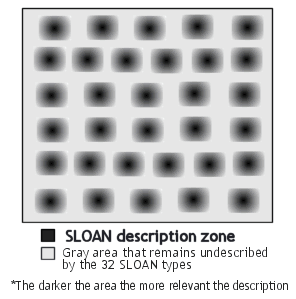
There are 32 SLOAN types; descriptions are listed here. Those 32 types do not fit everyone; they are merely 32 zones which cover much of the personality landscape. However, if you or someone else does not fit one of those types (because you score in between on one or more of the Global 5 elements), you will be able to infer a description from the types you fall between. There are an endless number of SLOAN+ types and if plotted to the personality space, they would leave no gray area. SLOAN tests Advantages of the Global 5 Every other current personality system (not based on the Big 5) suffers from unproven, unclear, non-independent, and/or non-unidimensional elements. The various Jung systems (MBTI, Socionics, Kiersey, etc.) come closest in usefulness to the Global 5 (correlations can be found if you click here), but only contain four elements. They say close to nothing about the Emotional Stability element. At least two of the four elements (Thinking/Feeling, Intuitive/Sensing) are not sufficiently unidimensional. For example, T/F covers aspects of Accommodation, Intellect, and Emotional Stability and N/S covers aspects of Intellect and Orderliness. This means a T could be an objective thinker, a selfish jerk, a stoic, or some combo of the three; there is no way to discern from the results. The Jung systems also pretend/infer that everyone fits into 16 types (most personality systems share this 'everyone fits one of our boxes' delusion). With five personality elements the least amount of boxes you can fit all people into with only general accuracy is 256. A weakness of the Big 5 theory is that there is some debate among researchers at what makes up the core of each element. To employ a geographic metaphor, there is agreement about what region each of the five elements are located in, but different researchers might disagree on what precise city in that region is the core or keystone of some elements. Nonetheless, as different as two researchers labels or descriptions of something like Accommodation might be (some label it Agreeableness), their descriptions are still more similar than dissimilar. The differences, in their most extreme, are in the order of orange vs. red, not blue vs. yellow. Nevertheless, while I think the Big Five was ground breaking as a rational empirical comprehensive model of personality, I began to find flaws in it over twenty years of research. The seven factor MOTIVES personality system is my solution to those issues.
|