 similarminds.com
A monthly look at you
Personality History
See how your personality stays steady and changes over time. Answer the same 54 statements about the past month, then follow your scores across 18 traits.
18 traits54 statementsOne check-in a month
Your month, in perspective
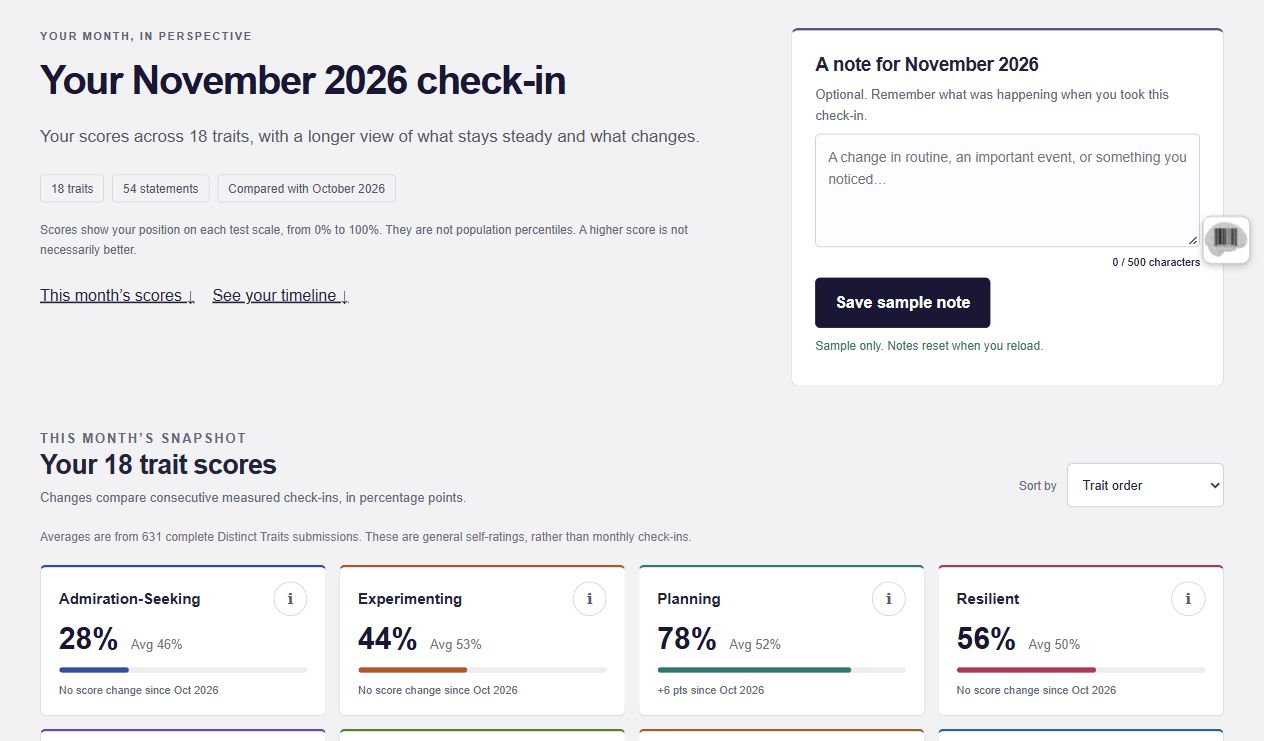
Each completed check-in gives you a result card for every trait, scored from 0% to 100%. See the change since your previous measured month, open a trait's info icon to read its description, and sort by trait order, largest change, highest score or difference from the sample average.
The smaller gray average beside each score comes from the Distinct Traits sample. It provides context from general self-ratings; it is not a monthly norm or a population percentile.
Based on your results
Below your monthly scores, four cards connect your check-in with other personality systems. The MOTIVES card shows a seven-letter code and your top two type tendencies, calculated from its 21 shared questions. Each code and type label links to its description.
The Big Five card shows an estimated SLOAN code and two leading type tendencies. This is a preliminary estimate from the shared MOTIVES dimensions, rather than a separately completed Big Five test. You can open the linked descriptions or take the 50-item Big Five test for a direct result.
How is the Big Five estimate calculated?
The current model was fitted to 76 paired profiles with short seven-point MOTIVES results and Big Five version 1.37 profile results. It predicts the five continuous Big Five scores from the seven MOTIVES dimensions using ridge regression. Five-fold outer cross-validation, with separate training-fold standardization and inner tuning, produced average absolute errors of about 8–13 score points across the five dimensions. It has not yet been validated against a separate sample of monthly History check-ins, so treat its letters and rankings as estimates, especially near a midpoint.
The two leading type tendencies are ranked by distance from the scale midpoint, including the low-scoring pole where appropriate. Ties can share a rank. Enneagram and Jung cards now show experimental estimates from paired Distinct Traits data. Read their validation results and limitations.
Experimental Jung and Enneagram estimates
These models use the 18 traits shared by Personality History and Distinct Traits. They were fitted to 67 paired Jung profiles and 50 paired Enneagram profiles, pooling the available seven-point Distinct Traits versions 1.14, 1.15 and 1.16 and multiple target questionnaire revisions. Profile and standalone seven-point forms are included; five-point results are excluded. Each profile contributes its latest saved pair. Profiles are not verified unique people.
The Jung model predicts Introversion, Intuition, Feeling and Judging scores, then uses their midpoints to make a tentative four-letter code. A midpoint can appear as X. The Enneagram model ranks nine type tendencies and shows the leading two. It predicts each type score relative to that profile’s average across the nine types; these rankings are not probabilities, measured Enneagram scores, or a wing estimate.
Both are experimental. Enneagram is explicitly labeled low confidence. Repeated nested cross-validation matched approximately 69% of Jung letters and 22% of complete Jung types. For Enneagram, the leading estimate matched the highest measured type in approximately 23% of cases; one of the two leading estimates matched in approximately 42%. A training-fold majority-type baseline matched about 5% of complete Jung types and 22% of Enneagram first choices (31% for the two most common Enneagram types). These small samples do not support confident personal classifications. As larger paired datasets become available, these models will be retrained and revalidated, with the aim of improving their accuracy.
Model and validation details
Each model is a regularized linear ridge regression on the 18 shared trait scores, standardized using training data only. The Jung targets are continuous 0–100 scores. Enneagram targets are centered within each profile to reduce overall response-level differences. The ridge penalty is selected from 3, 10, 30, 100 and 300 by four-fold inner cross-validation. Reported estimates average five separate five-fold outer runs; every held-out prediction is made without fitting or tuning on that profile. Target-revision holdouts were also checked. Repeating cross-validation does not add independent participants, and pooling questionnaire versions introduces additional uncertainty. These are exploratory development checks, not an independent validation study.
The models were trained on general self-ratings, while History asks about the past month. Transfer to monthly check-ins has not been independently validated. Close rankings or scores near the midpoint can change type easily. No age, gender, name or participant identifier is used as a predictor, and estimates do not count as completing a separate test or overwrite a saved direct-test result.
For a direct result, take the Jung test or Enneagram test. The estimate and its linked descriptions can be a starting point for exploration.
Follow the longer pattern
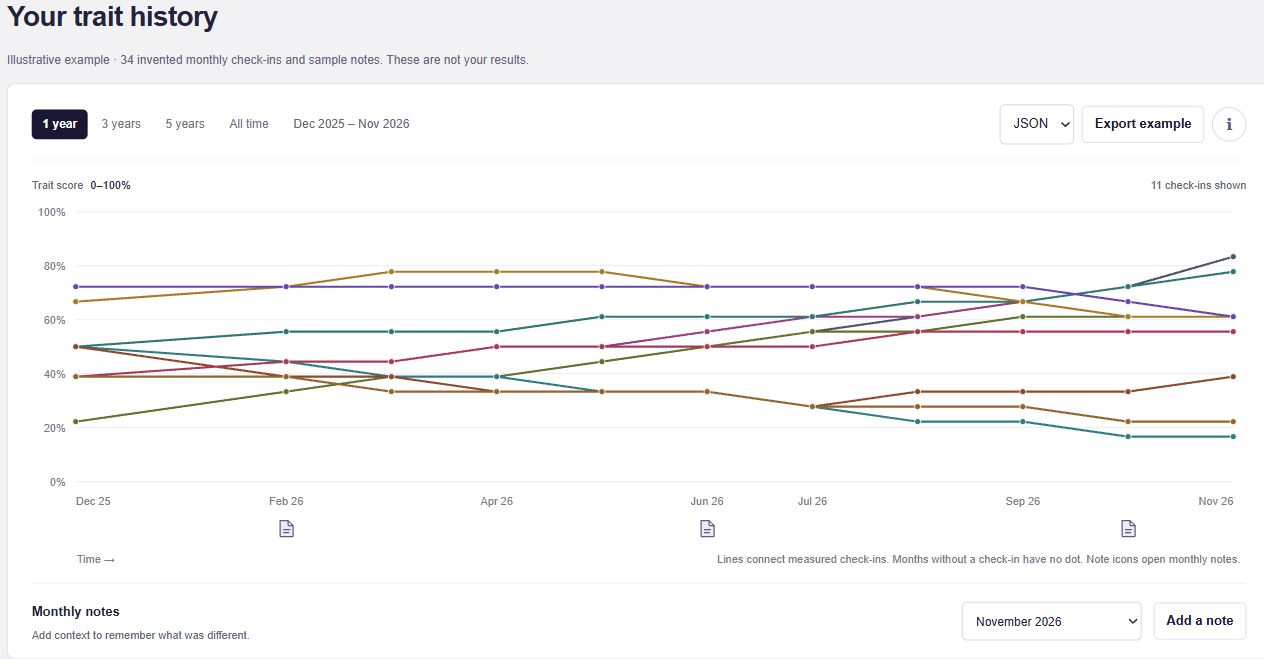
The timeline starts with one year. Expand it to three years, five years or all time. Each trait has a different colored line, with dots marking months when you completed a check-in. Lines connect your measured months, including across a skipped month; a month without a check-in has no dot.
The ten traits with the largest observed score ranges in the selected time frame are displayed by default. Use the checkboxes to choose different traits, up to ten at once. With your first check-in, you will see one set of dots; a second check-in lets you begin comparing change.
Keep the context, too
Add an optional note of up to 500 characters on your monthly results page. Record an event, a change in routine or something you noticed. You can edit a month's note later, and open it by clicking the note icon on the timeline.
Export your scores and notes together as JSON or CSV. The files include dates, trait names and score information so you can review them in a spreadsheet or provide them to an AI analysis tool. JSON preserves the structured history; CSV is convenient for tables. Your notes are included in the file you choose to export.
Make it a monthly habit
- Open Personality History and sign in to save your results to your private profile.
- Answer all 54 statements about the past month. The first check-in also asks your age and gender for research purposes only; those questions are not repeated after your first completed test.
- Review this month's scores, add a note if you want, and return next month to add another point to your history.
The monthly reminder is automatic. One reminder stays pending until you complete a check-in, so missed months do not turn into a stack of reminders.
Which traits are included?
The current test follows Admiration-Seeking, Experimenting, Planning, Resilient, Other-centric, Easygoing, Conservative, Intimacy-driven, Empirical, Social-cue difficulty, Food-oriented, Feelings-driven, Moderating, Present-focused, Mystical, Minimalistic, Ambiguity-tolerant and Active. Each trait uses three statements drawn from the Distinct Traits questionnaire.
How should I interpret a score change?
The percentage shows where your answers fall on the test scale. It is not your rank among other people, and a higher score is not necessarily better. Changes may reflect circumstances, how you understand an item, or measurement fluctuation as well as a changing tendency. “Most changing” describes observed score ranges, not statistically established personality change.
Who can see my history?
Your saved check-ins and monthly notes are private to your account. The sample-results page uses invented data and does not save a test to your account. Your own export includes your scores and notes, so you can choose where to use that file.
Browse all personality tests · About Distinct Traits · 中文人格历史测试